Fabianinkatu 28
Customer: Helsingin Yliopiston kiinteistöpalvelut Oy
Location: Fabianinkatu 28, Helsinki
Completed: 2025
Area: 3270 brm2
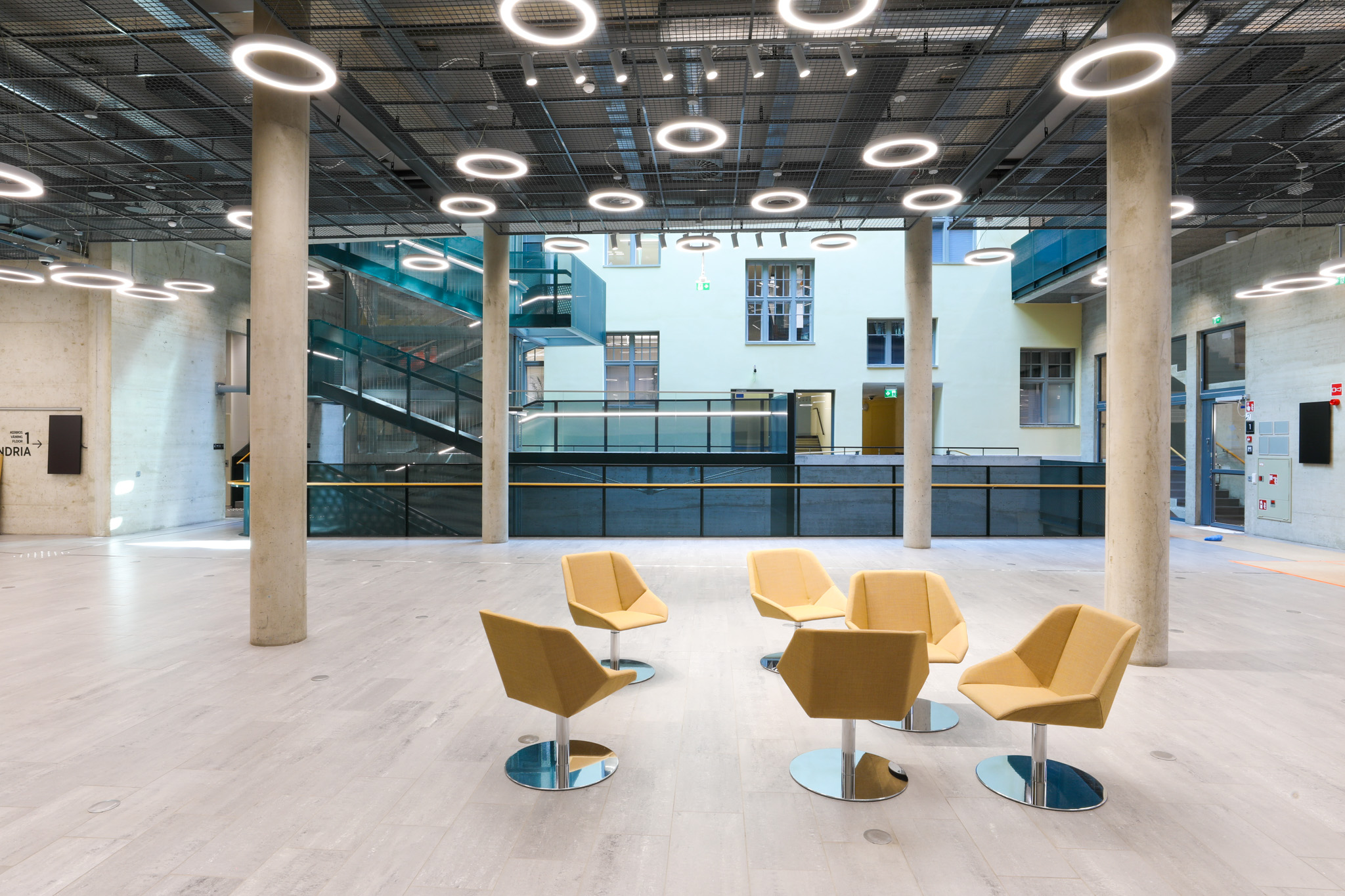
The new part of the University of Helsinki property, i.e. Learning Centre Aleksandria was designed by Arkkitehtitoimisto Aki Davidsson and completed in 2003. The Learning Centre was primarily in its originally designed form. Some of the most distinctive features of the building were a glass-roofed lightwell connecting the different floors, the façade with its colourful awnings, the fair-faced concrete surfaces of the main premises, with their mezzanines and bridges, and the complementary steel-glass wall structures with wood elements. During its completion, Aleksandria won the Concrete Building of the Year award.
In our renovation and alteration project, study facilities were developed to serve the needs of today’s multifaceted independent and group study. With the proliferation of distance learning, there was a desire for more silent spaces for both individual and group work. The goal was to offer an attractive study environment that promotes a sense of community, comfort and student well-being. The starting point of the design was to create an adaptable use of space to promote student work. Improving interior acoustics was another key design challenge in a concrete space with high ceilings.
In the renovation, the different floors were isolated from each other with sound-insulating glass walls, and passageways were rerouted with the installation of new staircases, thus enabling the simultaneous use of spaces for different functions. The previously unified, completely silent floor spaces were divided with glass walls based on future needs to enable functions with different sound levels. The first floor was modified into small group workspaces and also houses a workplace café and multi-purpose area. Floors 2-4 are open, adaptable group workspaces and study areas with desks. The Examinarium examination room is located on the fourth floor.
The original architecture of the building was honoured in the alteration work. In designing the spaces, new small rooms were concentrated on floor K1, thus allowing the utilities on other floors and ceiling structures to remain in place with minor adjustments. A new steel staircase was installed in the lightwell, which runs from ground level to the top floor of the building, providing a visually cohesive element. Flights from the removed steel staircase were reused as whole elements in the new staircase. Some of the furniture was restored and new furnishings were added.
In addition to functional alterations, structural parts were repaired and changes were made to the building utilities. University of Helsinki’s sustainable development goals for the circular economy, low energy consumption and carbon neutrality were taken into account in the project.